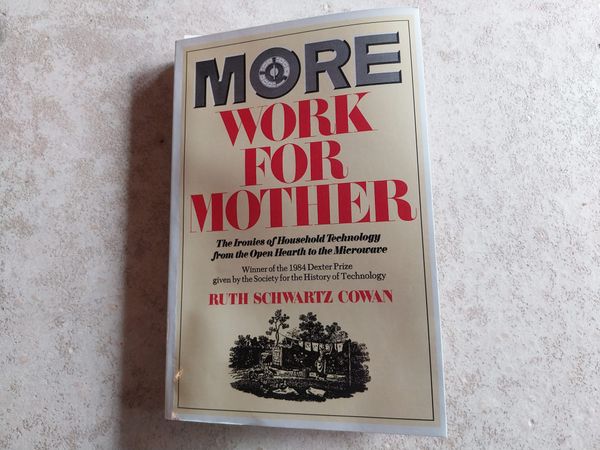
Documentpile: COM(2026) 503 final
In what will ideally not be the beginning of a new series, I give the bookpile treatment to a hot new document from the European Commission. The "Communication on European Tech Sovereignty, accompanied by an EU Open Source Strategy" isn't all great, but offers some specific hope.

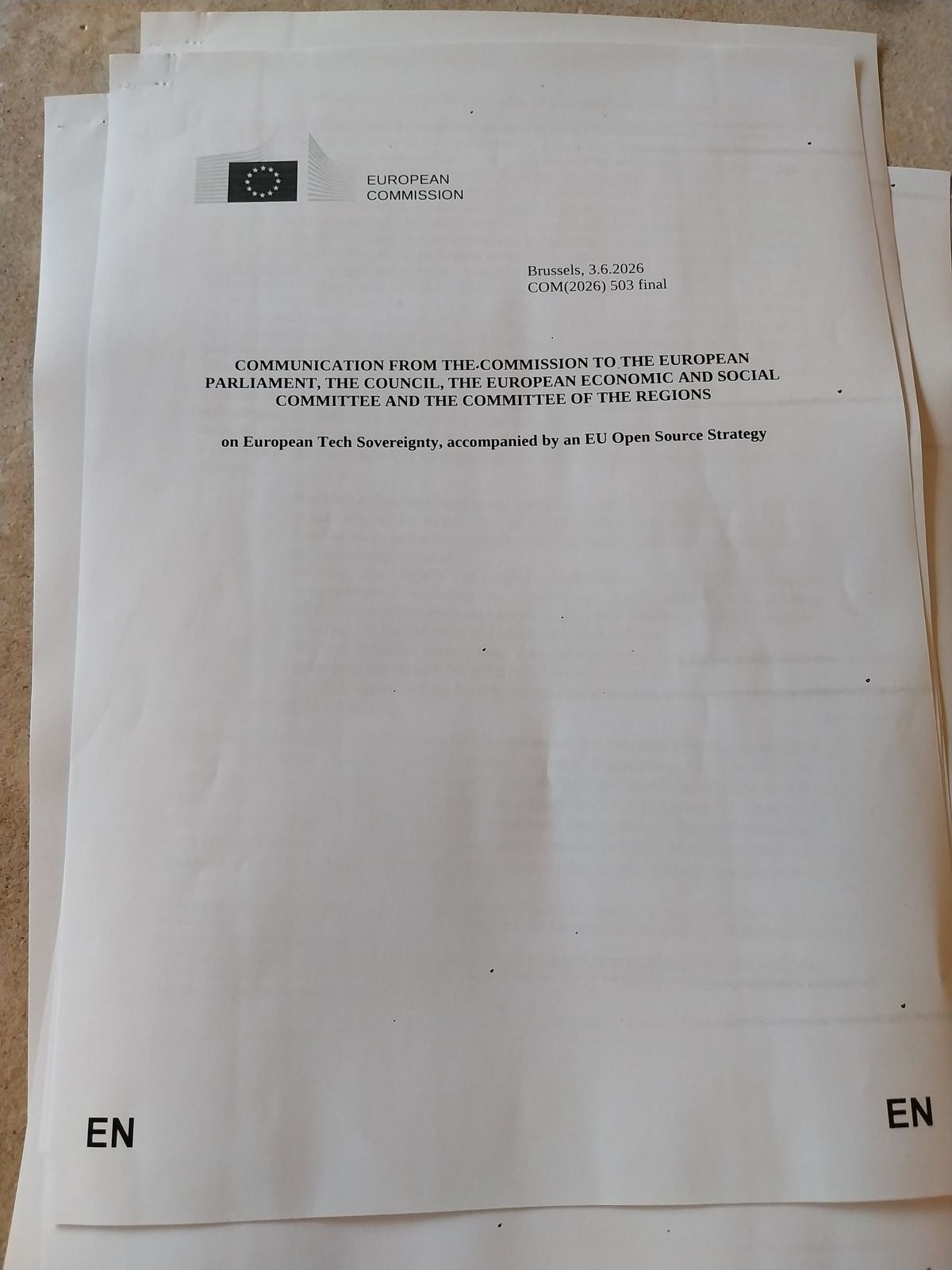
While I won't be making a habit of the "documentpile" genre, this one bears a look. On June 3rd, the European Commission (EC) released "COM(2026) 503 final," a communication on digital sovereignty and open source strategy. It has an exceptionally long official title, but the catchy short name is "Communication on European Tech Sovereignty, accompanied by an EU Open Source Strategy." This has been blowing up both my Mastodon feed and my LinkedIn, a crossover that happens relatively infrequently.
Basically, the EC is putting its stall out, articulating the connection between a few different legal and financial instruments, and laying out a vision for greater technical and strategic sovereignty in Europe. There's a lot in it about competitiveness, about not being left behind in various technological races, and about public support for the development of new technologies. I've already seen takes about the limited way in which sustainability and accountability in the construction of data centres is addressed, and the emphasis on AI is definitely quibble-worthy.
But! In this 28-page document, fully twelve pages are devoted to laying out an Open Source Strategy. What's really notable is the strong way the document links a healthy European Open Source ecosystem (I'm using the term "Open Source" when referencing the document, but will otherwise use "F/LOSS") to the potential for digital sovereignty. And in this section, the emphasis isn't on building more of the "AI Gigafactories" that are supposed to help Europe "catch up" with China and the United States. Rather, the emphasis is on wonderfully practical things like making government procurement friendlier to F/LOSS solutions, and the smaller suppliers who might be providing those solutions.
The Open Source Strategy is also grounded in maintenance, community, skills, and education. The actions outlined include making European bodies into exemplars for the adoption of F/LOSS, and valuing openness, interoperability, and the capacity for development and re-use elsewhere.
From the perspective of decoupling both education and public administration from US-based Big Tech vendors, the Open Source Strategy offers some hope. There's a clear position that Europe is the home of a lot of great work in F/LOSS, but that these brilliant communities and the things they make aren't sufficiently supported or leveraged.
The linkage the document makes between supporting European F/LOSS ecosystems and having greater technological sovereignty is, in itself, a sign that good things may be coming down the line. There's a lot to be critical about, of course, but the emphasis on supporting, promoting, maintaining, and deploying F/LOSS tools and solutions is heartening. Combined with the practicality of the proposed measures and the sensitivity to very specific issues in F/LOSS adoption, the wish to increase the visibility and adoption of F/LOSS feels like an important step towards a more resilient European digital ecosystem.
Read it yourself here: https://digital-strategy.ec.europa.eu/en/library/communication-european-tech-sovereignty-accompanied-eu-open-source-strategy