Food, capital, and work
Super-charged capitalism creates an environment where individuals feel the need to cram more day into their day. We still need to live, but time pressure presses down on our ability to do it without help. Enter solutions like the meal replacement drink.

I bought five bottles of Huel yesterday. (Other meal replacement drinks are available.) I bought this beverage because I know my week is going to be busy, and I want a backup plan in case I find myself in a situation where my nutrition will suffer if I have to make a “bad” choice about food. A choice deserving of the word “bad” in this context would be something that contains a lot of calories and not many micro-nutrients, something leaning too heavily on cheap, processed carbohydrates, or generally something that doesn’t carry its nutritional weight very well. As a vegan for more than half of my life, I am used to worrying that I may be getting too much of this, too little of that, or running some kind of structural deficit. I am used to sometimes spending a few months keeping a spreadsheet of everything I eat, so that I can monitor things like iron, calcium, B12, and selenium. I adjust what is in my diet on the basis of what I learn from the spreadsheet. These anxieties and record-keeping activities have become second nature, as veganism in the countries I’ve lived in is generally seen as either a punchline or a way to start a fight. People still want to know what I eat in a normal day, still want to tell me what animal-based foods they’d never be able to give up (because they’re just too delicious), still want to fret at me about some nutrient or other they think I probably don’t get enough of. A long-term vegan is either a skilled self-advocate or irritable, and often both.
So I bought the meal replacement drink. I bought the meal replacement drink for one of the main reasons provided by the marketing of these kinds of products: I don’t have time to be sure that I’m eating well. I have too many meetings, too many conferences, too many things this week to feel sure that I can do nutrition right, on my own and with whole foods. Instead, I want to open the damn bottle, drink the vanilla-flavoured beverage, and feel sure that I’ve now ticked a certain percentage of all the micro- and macro-nutrients I’ll need in my day off the list. This is why I bought the drink. This is how they sell the drink. The drink is for busy people who want to look after themselves without having to think too hard. The drink takes the thought out of nutrition.
To my mind, I’m not trying to optimize myself by buying and consuming the drink. I’m not trying to build more muscle or have better endurance. I’m not trying to crush a goal. Instead, I am trying to get through my white-collar, relatively well-bounded, just a little busier than usual, one-employer work week – ideally without making food choices that count as bad within my own framework of values, and within common nutritional guidelines.
Trade-offs
But this is, in fact, an attempt at self-optimization. It’s just not how we might expect such a thing to look. The thing in my life that I’m seeking to optimize is the relationship between my work responsibilities and my nutrition. I am optimizing, in that I’m trying to find an efficiency where I would otherwise have to give something up. I could spend more of my weekend doing meal preparation, making sure I have easy and healthy things to throw in my bag as I leave the house on those busy days. I could drop a leisure activity to do that meal prep, or I could be awake a little longer and sleep a little less. Instead, I’ve bought the beverage. In my value system, buying the beverage feels like failing, but I grit my teeth and do it. It feels like a compromise I’ve had to make, as I navigate a month that’s busier than usual. But ultimately, the choice to buy the beverage is one with a rational basis, and it is a form of optimization: I’m looking at what I value in my life, at how I want to spend my time, at what can give, when something has to give, and I’m buying the beverage. In the current situation, the meal-replacement drink feels like a reasonable choice.
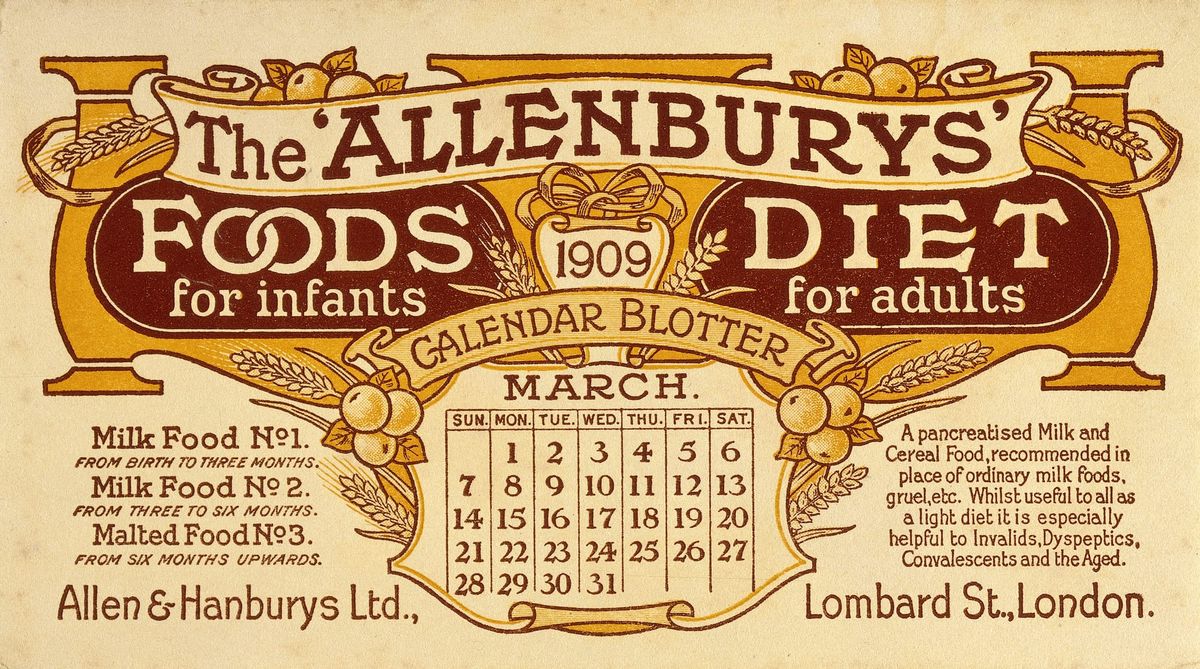
Now, the important question: how the ever-loving fudge did we get to this point? Not how did I get to this point – we did that one in the previous paragraph. But how did we, as a society, get here? How did we get to the place where I can go to the sport/conscious nutrition section of a regular Dutch grocery store and buy such a thing as a bottle of drink that contains about 20% of a theoretically average person’s nutritional needs for a day? This has been a long time coming. Not just the fifteen or so years that this new generation of meal-replacement drinks has been on the market, and not the significantly longer period of time during which less cool-coded meal replacements existed for other audiences and other purposes. The long time is much longer indeed, and it ties into how we understand nutrition, how we understand our bodies, and how we reproduce our labour within systems which are very interested in extracting as much profit as possible on both sides of the ledger.
This time around, I’m not going to go back as far as Jeremy Bentham and his ideas about cooking for the inmates of his famous (never fully-realized) panopticon. Remind me another time. I’m similarly not going to do how affordable sugar from slave colonies created cheap, fast calories for labourers in new and growing industrial cities (sugary tea: the energy drink of the industrial revolution). In fact, I’m going to skip the history entirely and look at the question of profiting on both sides of the ledger.
If you’re too tired from your busy life, you can buy an energy drink. Apparently some of them give you wings, which sounds pretty good. It’s faster than coffee, has all kinds of extra stuff beyond caffeine, and tastes like, well, not coffee. But if you want a coffee, there’s a cold one in the same refrigerator case, with a shedload of sugar and a nice hit of milk (or oat, if you prefer). If you don’t need coffee instantly, apparently there’s a major chain where you can now get one with protein foam. Which is probably good, because protein is the “it” macro-nutrient right now. The world is, in short, rich with ways to steal a little extra energy, a little extra nutrition, a little extra power from your day, as long as you can pay for it. This is the double-profit of capital from our collective busy-ness.
The reproduction of labour power
I’m going to take a tiny detour into Marxian political economy. Don’t worry, it’ll be brief. Ignoring for a moment all the things one may enjoy about one’s work, one of the major motivators for work, in a capitalist economy, is the paycheque. We get paid to work, and we spend that money on the things in our lives that help us live, maybe even thrive and have a nice time. But in order to be able to work, certain conditions need to be met. We need to get to work in a state fit for the work we need to do. For most people and jobs, that means being sufficiently well-rested, fed, clothed, and ideally being in a state of mind conducive to doing our jobs. All of the unpaid work that goes into being in that state when we arrive at work is called the reproduction of labour power. A lot of stuff happens at home that contributes to our ability to be productive at work. The reproduction of labour power is something that, in a historical household with a working man and a stay-at-home woman, is performed, for free, by that woman. This was a hot topic for feminist political economists and activists a couple decades ago, and the question of pay for housework comes around again every once in a while. As does the question of the economic contributions of unpaid housework to the gross domestic product of any given country. A lot of unpaid labour happens at home. Indeed, our economies wouldn’t work if the tasks that reproduce labour power were to suddenly grind to a halt.
But we’re not living in a world any more of nuclear families made of men who work for money while women handle the reproduction of labour power by staying home and cooking (and cleaning, and doing laundry, and ironing, and looking after the children, and...). Instead, there are more dual-income households, there are more households made up of individuals, and there are any number of configurations that don’t map to the idea that a household is anchored on two adults, one who gets paid to work and one who does the labour to make that work possible.
Buying time
This is where our old friend (or "friend") the market steps in. People have less time, everyone is working, but we still need to eat, sleep, care for ourselves, and generally be capable of engaging in work when we’re at work. So we get things like half-prepped meals that just need to be cooked, frozen food more appetizing than the TV dinners of the past, armies of delivery bikers bringing meals from any number of restaurants, and yes, the attractive and practical meal replacement drink. In a social and economic situation in which the idea that one person in a household devotes their life to making things easy for the money-earner is either laughable or, for some people who like that kind of thing, merely unattainably aspirational, something has to give. Some things in the reproduction of labour power need to become easier. And that’s not generally happening through communal housekeeping (though if you want to read about the history and politics of housework, with a detour into communal housekeeping, then do check out Ruth Schwartz Cowan’s excellent book, More Work for Mother).
Instead of communal housekeeping, or the provision of services by government or collectives within civil society, for the vast majority of people (in Westernized societies – I'm not aiming to make claims for people beyond my own broad field of experience), the question of clawing back some time is answered by purchasing new products. This doesn't exclusively happen with food, but also touches on other parts of the reproduction of labour. You can buy clothing that's easier to care for than the old stuff, and never needs to be ironed (but you're still going to wash it more than people used to, because that laundry machine in your house makes it comparatively easy to do so – see Ruth Schwartz Cowan again on the question of inflation of expectations in housework as a result of automation). You can buy a robot vacuum cleaner to automate the floor cleaning. And yes, food has also gotten much easier to make than it used to be. Each of these solutions to the question of tight time and high expectations is an attempt to find a trade-off between the things we need to achieve with our non-work time, and the lack of that time.
The answer to my question from above, then, about how the ever-loving fudge we got here, is essentially just the massive changes to the global economy that have taken place over the last 40 or so neoliberal years, combined with the imperative to get a better life by buying it. The neoliberalisation of our economies has led to super-charged profit-seeking by companies, with with comparatively fewer guardrails and mechanisms for social re-distribution.
This lack of oversight and re-distribution (for example, via taxing people and companies earning a lot of money) brings us to a place where expectations of dedication to work are sky-high, contracts are insecure, and the threat of automation through the use of some nebulous, AI-based intervention looms over the ability of individuals to make healthy choices about their work. Is it any wonder that buying a little extra time now feels like a reasonable choice? And, because our hyper-charged capitalism is great at profiting on both sides of the ledger, the market-based solutions to lack of time are also earners. Each individual may be making a choice about what feels right or rational for them, but collectively, they're contributing to the profits of the companies selling the ready meals and robot vacuum cleaners.