Making is political
Making things yourself can be a political act. Does doing it yourself offer a meaningful opportunity to challenge hegemonic political structures? It depends on how you see the politics of consumption.

There’s an ungodly tangle in my head where Buy Nothing Day, Karl Marx, lactofermentation, making dinner with friends, fixing things, and thrifting are all jumbled together in some kind of spaghetti monster or rat king (but don't click that last link if you're squeamish) of intertwined meaning. That’s a really opaque and pretentious way of saying that I’m trying to untangle what I now know about political economic theory, activism, and capitalism, from a lifetime of enjoying and feeling satisfaction from making and fixing things. It’s a hell of a tangle.
I’m going to do my best to sort out this mess of meanings and lay out the metaphorical strands, because there’s a broader benefit to understanding the relationship between making/doing things ourselves and the current state of capitalism and consumption. There are a couple of important questions I want to try to address here. Those are: What are the politics of making? Can we be empowered by making? When is making just another flavour of consumption, when is it something different, and does that difference matter?
Let’s start with some definitions. What do I mean when I talk about making? Broadly, I mean doing hands-on activities that fulfil one’s own needs and desires, or the needs and desires of those close to us, without expecting direct financial compensation or profit for our efforts. Making or doing it yourself (DIY) or doing it with others (DIWO), in the sense I’m using in this essay, are not business activities, but personal and community ones. In practice, the boundaries are blurry – many businesses have come out of the “Maker” movement and in some countries, the term “DIY” has less of a political meaning and simply connotes doing activities like home renovations (and the retail outlets selling the goods needed to do those activities). But I’m taking another meaning, which in one genealogy comes from punk (though if you want an academic counter-argument to the link between DIY and punk, here's one), that self-production can be a form of radical independence and expression, and indeed, can be an act of resistance and a rejection of hegemonic social and political structures.
DIY emancipation
Why am I suddenly writing so much about the need to do things that challenge power structures? (Joke’s on you: that’s basically what I’m always writing about – it’s just a little more overt in these last few essays.) I’m on a bit of a small-scale activism crusade at the moment because a lot of big and scary things are happening in the world. One totally reasonable response to that is to crawl into a hole and try to ignore it all – I know many reasonable people who are avoiding consuming news at the moment. Another approach is to go out and protest. A third response, and the one I want to un-pick today, is trying to find small and manageable areas in life where it’s possible to feel that we’re making a difference. Most of the donations I make to NGOs were prompted not by campaigns from the groups I donate to, but because I've read something depressing and want to try to make a difference (for example, being sad about Dutch surveillance culture prompted me to start donating to Bits of Freedom). But we can do things beyond giving money to organizations pushing the agendas we want to support. Indeed, if you have spare money, giving it to good causes is about the easiest form of activism available. Much harder is identifying how the everyday aspects of our lives contribute to our own subjugation or emancipation, or to the subjugation or emancipation of others, and then trying to make changes.
How does making come into emancipation? I suggested above that one of the values we can find in the DIY culture of punk (circa the late 1970s–early 1980s) is the rejection of hegemonic structures. But what does that look like? In punk’s case, it was the rejection of mainstream aesthetic values in favour of confrontational and home-made or -modified garments; the self-production, distribution, and performance of music; and the development of a subculture through the publication of zines. In an age before the internet, the ability to create one’s own platform, without the help of existing cultural gatekeepers was absolutely not a given. One reason that punk culture gets such a big hat-tip in the history of DIY as a political act is this creation of an oppositional and counter-cultural way of producing music, fashion, and modes of living. This is one form of emancipation through making.
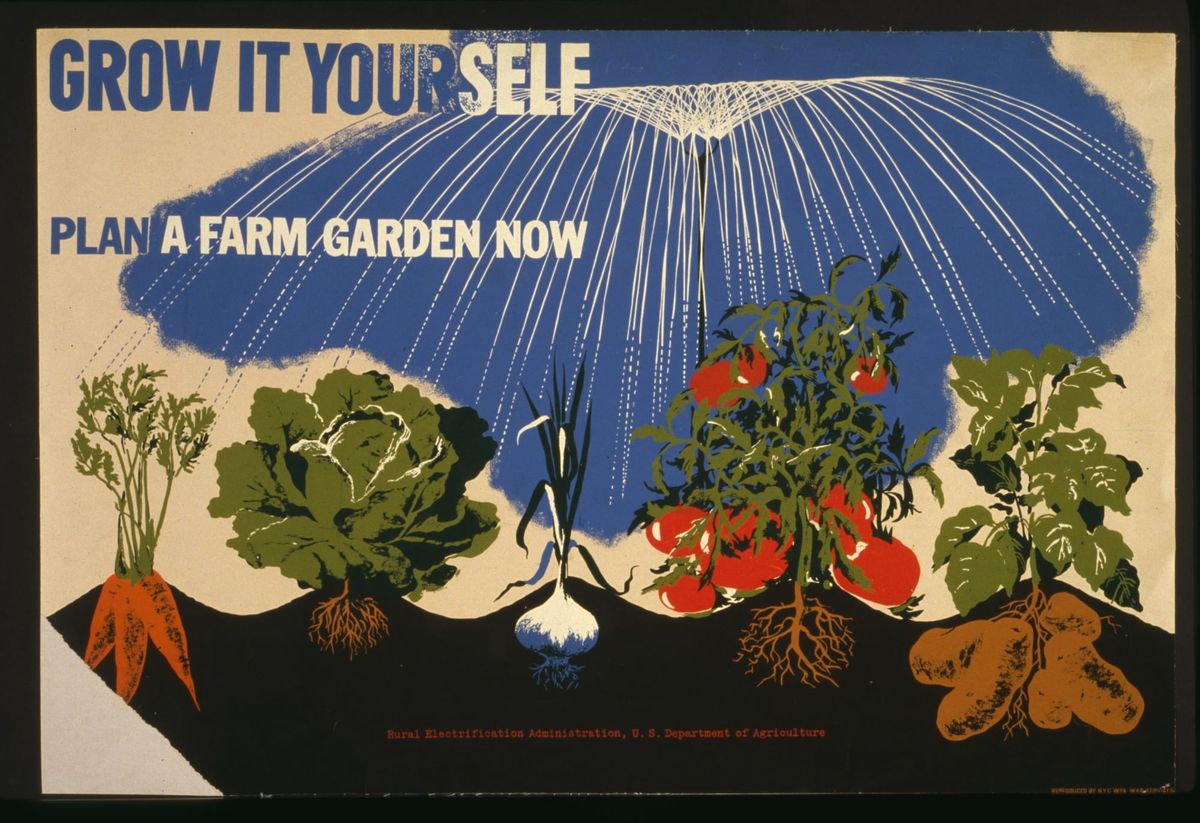
Different forms of emancipation (or empowerment) through making come from other counter-cultures. Various back-to-the-land and self-sufficiency movements over the last hundred years can be seen in relation to the exigencies of economic and political forces, and are, in their own ways, efforts to become free from the difficulties or mis-fits of a hegemonic system. (And on the flip side, food self-sufficiency suddenly became a governmental push during WWII, when commercial food crops needed to be diverted to the war effort. But I digress.) Here and now, can I really argue that making my own sauerkraut or mending instead of replacing is a meaningful effort at emancipation/empowerment, or constitutes a political action? It depends, I think, on how you see the politics of consumption.
The economics of consumption are political
I'd argue that the imperative to feed one's country's gross domestic product (GDP) or general economic productivity through personal spending is, while currently very normalized, a fundamentally political choice, dressed up in the language of economics (which is, in itself, political). Consumer spending as a metric of national economic well-being places a heck of an onus on the average person to, well, spend. If one of our baseline duties as people living in capitalist societies is to spend money for the sake of the economy, then anything encouraging a voluntary reduction in spending turns out to be a very political choice. So while my sauerkraut may not be doing much, since I still have to buy the cabbage, repairing an appliance to give it a longer life may well turn out to be a more meaningful intervention. Even if neither act, on its own, has a major effect externally, systematically making and promoting choices which involve frugality and self-making or repair is a different orientation than the default spending imperative.
The GDP angle isn't the only thing about making that we can look at with a political angle. Making or doing things ourselves requires skills, time, and potentially even sharing and collaborating with others. Diverting time away from tasks seen as economically productive is a political choice, as is the development of skills which are used for yourself and your community, rather than directly for economic productivity. Learning skills through and for making things could, of course, contribute to one's job market positioning. This is one of the arguments that's sometimes visible in initiatives which present hands-on skills as future-oriented, or levelling-up. Such ways of positioning making are, yes, also political – they turn the pleasure of making into a gateway practice for job acquisition or entrepreneurship. If we avoid these logics and view making as something done for personal and community benefit, for curiosity and learning, or for frugality and environmental consciousness, the same acts take on very different politics.
Anti-consumption making
A paragraph or two ago, I compared sauerkraut to appliance repair. I positioned my sauerkraut as being not particularly anti-capitalistic or disruptive of market-oriented thinking because I still have to buy the cabbage (I do not currently grow my own cabbage, or this would be a different discussion). It raises a relevant question: When is making just another flavour of consumption, and when is it something different? Can we, and should we, draw lines around what constitutes a primarily consumption-oriented form of making, and what kinds of making are challenging to the primacy of consumption? It depends! As with many things, it depends on the motivation behind the act. If you've been reading this essay and thinking "I don't care if it's political, I just like knitting!" then trying to define whether your making is consumptive or anti-consumption feels far less necessary. Normal considerations apply around ethical issues like environmental responsibility or human rights, but if those are things you evaluate your consumption decisions on anyway, then they'll probably also be playing into the way you consider consumption choices in your making practice. But even if your making isn't explicitly about challenging the culture of consumption, it could still be helping develop your feelings of self-efficacy, and it could be a catalyst for building community.
But let's get back to talking about the alternative. What does it take to consider making as an anti-consumption activity? Are we fooling ourselves if we strive to disrupt our market-oriented lives through activities like mending and gardening? One of my first encounters with making and DIY as political acts was attending a Buy Nothing Day fair. If you're unfamiliar with Buy Nothing Day, it's an initiative that encourages people to, well, buy nothing for a day and protest consumption. It's been chugging along nicely since the 90s, and that fair I attended was a beautiful example of people getting together to share and barter. I think someone was giving out free haircuts. This may not be an easy way to live every day, but the significance of Buy Nothing Day is not in trying to start a bunch of communes. Instead, it's in highlighting the dominance of consumption in society, and attempting, however briefly, to disrupt it, whether through protests, clothings swaps, or flyering.
This, then, is DIY at its most overtly political. It sits alongside other initiatives and activities like swap shops, community garden seed exchanges, and skill sharing. What these activities have in common is an effort to share, reduce wasteful use of resources, and disrupt standard patterns of consumption. Many forms of making and DIY can and do fit under this umbrella. Any time you salvage an old piece of electronics for its components, any time you stash destroyed clothes away to use as fabric scraps, you're rejecting the waste endemic in society, and doing a move towards repair and regenerative forms of making.