The hand of the web designer
The humanity and individuality of the web designer becomes more important under automated production. The advent of consumer-facing large language models which spit out on-demand code brings web design squarely into the category of automated production. But I'd rather see an ugly website.

In Neal Stephenson's sci-fi classic, The Diamond Age, a technology called "the feed" ensures that the supply of cheap goods and materials is taken care of – anyone can access the feed, and through feed-enabled vending machines, get the basics needed for life, extruded and assembled with the help of nanotechnology, like a kind of 3D printing plus plus. The result of this universal access to needed goods is, of course, that the rich in their enclaves come to prize items that are handmade and artisanal. When everyone can have access to everything, cheaply and easily, the unique and the handmade gain extra value.
I'm reminded of The Diamond Age by the way my own taste in web design has recently and viscerally changed. While I was never one for the super-slick, trend-conforming style of web design, I've recently become even more entrenched in my DIY aesthetic. The advent of visually-polished, semi-automatically extruded vibe-coded websites which share a kind of sameness, and the ease of producing these, makes me even fonder of websites which show the hand and the effort of their creators and maintainers.
The humanity and individuality of the web designer (or any designer/maker/artist, but let's stick with web design for now) becomes more important under automated production. The advent of consumer-facing large language models which spit out on-demand code brings web design squarely into the category of automated production. (I hear the quibble coming: we've had What You See Is What You Get [WYSIWYG] website-generation software for decades – but at least with those, you still had to design the website yourself, even if the code was then generated for you.) And with the yet-further automation of web design come new relations between the website and those who engage with it.
The loud type choice
Many years ago, I worked as a web designer for a company making easy-to-edit websites for small businesses. Because the value proposition of the product was that clients wouldn't be reliant on us to update their websites, the use of an easy content management system (CMS) was important. The side effect, though, was that clients did not confine themselves to changing texts or adding photos to their websites once they got the proverbial keys handed over. On one memorable occasion, I looked at a website a few months after delivery and found that the careful typeface choices of the colleague who made it had been totally upended, with all body text now rendered in massive, yellow Comic Sans. At the time, I found it a little baffling and aggravating that a client would invest money in getting something designed, only to undo the work of the designer. A taste for massive, yellow text is something very personal, not aligning with even basic principles like having a decent contrast ratio between text and background to facilitate accessibility.
While I'm still not on-board with low-contrast text on websites, my attitude towards that yellow Comic Sans has changed in the intervening years, and especially recently. With the advent of vibe-coded websites, and with a homogeneous style of "design" (I'm not sure we can really call these things designed, but that's another essay) coming out of products like Gemini and ChatGPT, anything that shows human intent and action feels more valuable to me. Where I might previously have been a classic judgemental designer, I'm now just happy to see that someone is bothering to make their website a little more personal. I was reminded of this recently when checking the opening hours of a small farmshop, the text all red and bold, and the website clearly being maintained diligently by someone who apparently likes bold, red text. It felt human, and it felt real.
I'm aware of the counter-argument that's often deployed to support the production of things like websites through fully-automated tools: "Using an LLM/chatbot/genAI thing makes creative tasks easier – what would previously have taken a day instead takes an hour. I wouldn't have done this if I'd had to do it manually." I hear this argument not just from strawmen on the internet, but also from people I know and work with. People who don't believe they have the capacity or the time (sometimes both) to make a thing (whether it's a website, a flyer, an illustration...) are pleased that they can have the thing made for them with comparative ease.
This brings me back to the websites with the loud type. They aren't polished. They may look like they're from 2015. The contrast may be incredibly poor (which I'll reiterate, is not a good thing, from an accessibility standpoint, so isn't to-be-encouraged). But gosh darn it, what the big, yellow Comic Sans or the all-bolded red mean is that someone has put effort into making a specific choice about the design of their website. A real person looked at that website and thought "it's fine, but the text should be bigger, and yellow, and more fun." What's more, they've gained the level of skill they need to make it their own. They've gotten into the back end and bothered to press the buttons or change the mark-up to do something to the website that will make them like it better. That's a win, in and of itself.
Arts and crafts
I started this essay with The Diamond Age, so let's take inspiration from it again as we end. The little enclave of craft-lovers we meet in the book is a very neat and tidy juxtaposition of small-scale artisanry against unconstrained mass consumption. Revelling in individual items made by human craftspeople has extra potency when consumption is otherwise only an automat away. Importantly, that juxtaposition mirrors historical reality. At the end of the 19th century, the Arts and Crafts movement was among the more prominent examples of a pushback against industrial manufacturing. We have been here before.
Proponents of the Arts and Crafts mentality were reacting against the glut of mass-produced goods coming into the market at the end of the 19th century, filling the homes of the new middle classes with bric-a-brac. Members of the Arts and Crafts movement championed conscious forms of production and consumption, goods made with care and attention, by artisans instead of factory labourers. We know what's happened in the intervening years. Broadly, mass production has won out, with both good and bad effects. But craft has not died. People still take pleasure in learning artisanal methods of production, and other people still take pleasure in using the items made by those artisans.
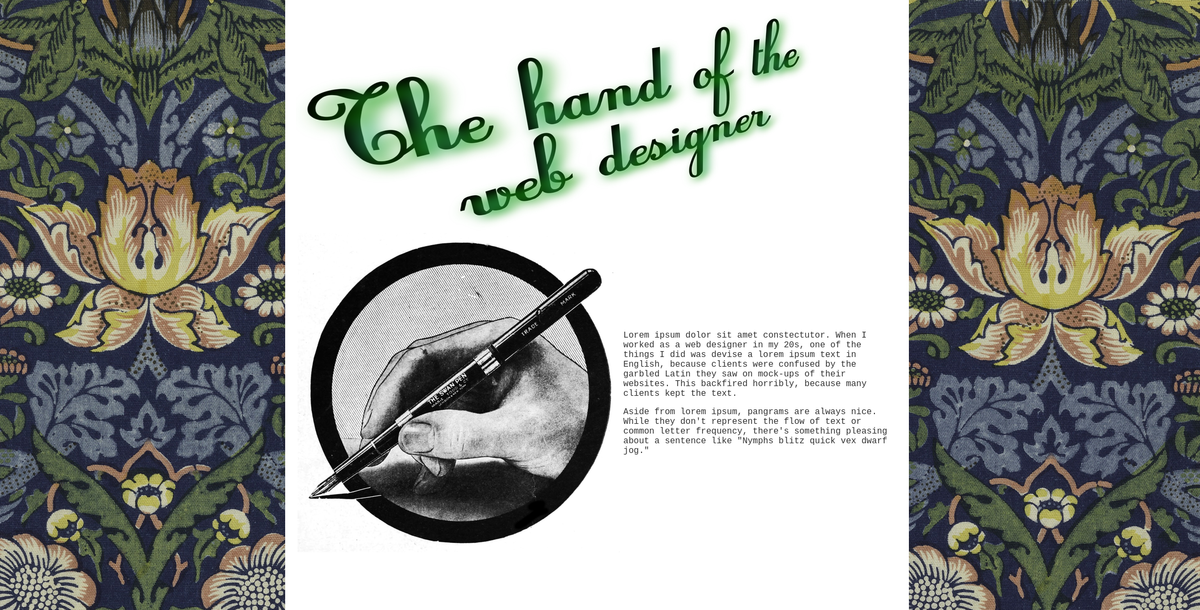
The effects of rampant mass-consumption have been, to put it gently, not so great. While many consumer goods may improve quality of life, we've reached the point of diminishing returns – there's too much shit in the world, and it's doing harm. And now you can make a website as easily as prompting an LLM. As with other forms of apparently frictionless mass production and consumption, there's increasing importance in asking whether each new thing is needed, whether it's doing a degree of good in the world or is just more tat. At this stage, I'd rather see the hand of the web designer, the conscious effort, the time and friction it took to make something, the ugly choice.