
Understanding work (part 2)
In part two of "Understanding work," a brief trip into productivity; the Luddites were onto something; and half the world now works in the tertiary sector. What happens when the quest for higher productivity comes for the service jobs? (Spoiler: it already has.)

Productivity
Let's return to the premise I set up in part one: in an ideal world, the work we do contributes to the good running of the societies we live in, and to our own well-being as individuals. We’ve already gone over the concept of the three sectors of the economy and the share they have of employment and economic contribution. It may seem a little backwards that the things we most need to live – food, water, shelter, clothes, and heat – are supplied by the primary and secondary sectors, while most employment and growth in both the OECD and globally now comes out of the tertiary sector. But this is where things get interesting. The employment share of the primary sector especially, but also the secondary sector, has been able to decrease in part thanks to increases in productivity.
Let’s look at the OECD’s definition of productivity. It is “a ratio between the volume of output and the volume of inputs” (OECD 2024, p.5). Realizing that the definition of an input could be thorny, they elaborate, writing that productivity “measures how efficiently production inputs, such as labour and capital, are being used in an economy to produce a given level of output” (ibid). So that’s pretty easy: productivity is how much output you get from your given inputs, and inputs are everything from labour to money to materials. If we take that back to Adam Smith’s pins from part one of this essay, the main inputs are steel, labour, money, and equipment, and the outputs are pins. If we can get more pins out of the same inputs by changing the methods we use (for example, dividing the labour into specialized tasks, or using some capital to buy new machines), we’ve increased our productivity. Very often, increases to productivity are achieved by changing the way labour fits into the production equation.
It's good to be a Luddite
The elephant in the room is that one of the big contributors to increased productivity is mechanization. The use of new machines to complete tasks reduces the need for human labour in those tasks. This is one of the old stories in industrialization, and worker movements fighting back against the mechanization of their jobs gave us the word “Luddite” for someone who fights against new technology. In 19th century England, the so-called “frame breakers” engaged in destruction of new machinery in (particularly) the textile industry. These protesters called themselves Luddites after a fictional frame breaker, Ned Ludd. The crux of their concern was that the introduction of machines like power looms would render them jobless or, for those getting to keep their jobs, the pace would change (becoming determined by the pace of the machine, not the worker), and the tasks would be de-skilled. These workers weren’t protesting the existence of the machines, but the impact that mechanization, when deployed by factory owners interested in getting more output with fewer costs, would have on the nature of their work.
Concerns by workers over the organization of labour and the quest for increased productivity in the secondary sector didn’t stop with the Luddites. There has been a tension throughout the centuries since industrialization between those who earn a living from making things and those who profit from their labour. The Luddites are so iconic because they occupy a dual role: for those supportive of their goals, they were aiming to preserve a degree of control and skill in their work. This is a classic struggle that still resonates today. The other side of the role of Luddites in the history of work and technology is how they’re remembered. Common language use places “Luddite” as meaning someone who is afraid of or resistant to new technology. It paints those who protested the use of power looms as being unreasonably resistant to technological progress. This is a convenient narrative to have available when those pushing for particular forms of technology adoption are also those who stand to profit. That tension embodied in the Luddites is just as relevant now as it was two centuries ago.
The shift to the service sector
The story of the last hundred or so years has been the story of a continuing move from primary sector work into secondary sector work, consolidation of populations in cities, and the eventual move into the tertiary sector as changes to the nature of work and productivity in the secondary sector took place. As I mentioned in part one of this essay, the tertiary sector is providing an ever-increasing share of employment. According to statistics from the International Labour Organization (via its parent, the United Nations) by 2023, 50.3 percent of all employment worldwide was in the service sector.
The global trend towards tertiary sector employment is stark: between 2005 and 2023, the share of employment in services rose by eight percentage points, at the expense of the agricultural sector. Different regions and countries have variations in trends, and the industrial sector has had a modicum of global growth, but an extreme version is visible in the European Union. In the EU in its totality, the years between 2005 and 2023 show a decline in both agricultural and industrial sector employment, and a commensurate increase in the service sector. A tiny 3.8 percent of employment in the EU is in agriculture, and industrial employment dropped four percentage points, below a quarter of all employment (24.3%).
The EU’s story is not everyone’s story, but there are regional trends visible. Narratives you may have heard about the trajectory many countries follow, from agricultural employment, to industrial employment, culminating in a heavy emphasis on the service sector seem to be playing out. On a regional level and within our 2005-2023 timeframe, we can stick a pin into our statistics and find that Northern Africa is farming significantly less (from 32.8% down to 21.5%), industry-ing slightly more (22.2% up to 26.1%), and servicing much more (45.0% up to 52.4%). Central Asia is on a similar line: much less agriculture, with some of the difference going to increased industrial employment, but more of it going to the service sector. At the extreme end of the spectrum, Northern Europe takes the blue ribbon for reliance on service sector employment, with 79.8% in 2023. That’s up from 74.1% in 2005. Where did those percentage points come from? 1.1 came from agriculture, but the rest came from industry.
Now, why the labour statistics? One thing that becomes very evident from the parade of stats is that there is a move, at varying paces and with varying intensity, but a move none the less, to economies in which most employment takes place in the service sector. This seems fine and dandy if you’re an adherent of the idea that the service sector provides work that is somehow inherently nicer, safer, better-paid or any other comparison that places it above other sectors in terms of quality of employment. It’s fine that the farm has been consolidated into a much-larger agribusiness, because all the farm kids have moved to the city and gotten desk jobs. But what we miss in that characterization is that the technologies of control, scale, and consolidation that took the skill and agency out of agricultural and industrial work are also taking things we value out of service work.
The world doesn’t need yet another essay about the often terrible working conditions of Amazon delivery drivers, but they, along with workers in fulfilment centres, are among the canaries in the coal mine (another extractive industry that has diminished in importance as an employer within the last half century). The mechanisms of control which turned fabric weaving from a skilled craft into something which uses workers as a supplement to the needs of mechanization and automation are also coming for service sector work. The task of the worker is increasingly to be a human assistant to the edicts or requirements of a machine (Cory Doctorow calls this a reverse centaur).
Automation in the tertiary sector
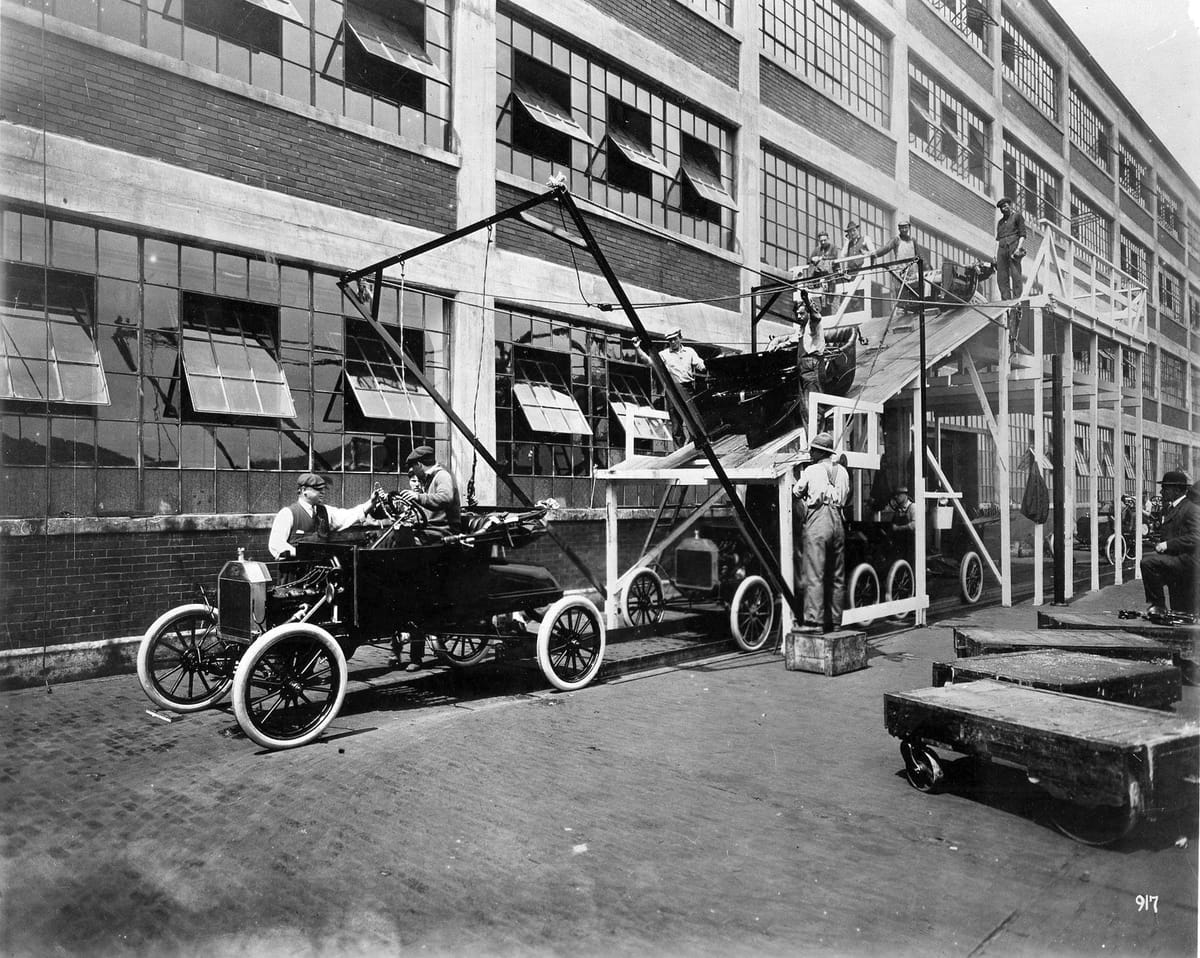
It’s not just the delivery drivers. I’ve written before about the risk of automation which integrates data collection by-design, and about the potential for over-reliance on “smart” tools and systems. The collection of data about how work is done doesn’t just surveil workers, it also makes it easier to de-skill and reduce agency. This is not an accident. The development of the Fordist system of production line manufacturing went hand-in-hand with the growth of scientific management as a field and with time and motion studies as a method for its implementation. To put it briefly, making a granular study of the motions involved in the completion of a task allowed those practising scientific management to intervene in the physical labour of their workers. If a manager of physical labourers has the belief that they understand how the labour is being done, and believes that the labour can be done differently in order to make it more efficient, there’s a financial argument for removing agency from the worker in the performance of their labour. This doesn’t only apply to developing a more efficient way to load pig iron into a furnace. It applies, of course, to the worker in the fulfilment centre who is told in what sequence to pick items off of shelves, and how quickly that should happen. It applies to a remote worker whose keystrokes are logged, and it applies to a call centre worker who is being monitored for speed and compliance. The creation of data about how we work and what we are producing is now more efficient than it was in the early days of scientific management – it no longer takes a man with a stopwatch, or analysis of photos, to collect data on how a worker completes a task.
Labour costs money because a dignified life costs money. We do the jobs we do for many reasons, but most of us work at least in part because it provides us with the income that makes life possible. The employment share of the agricultural sector has not diminished because people don’t eat food any more. Revolutions in efficiency and changes to the structure of farming have made it possible to feed the world without half the working population being agricultural labourers. Personally, I’m not sad that I grew up in a city instead of on a cattle farm, and I’m not making the argument that the diminution of labour share in fields like agriculture and manufacturing is a bad thing. But if there’s one thing we can learn from efficiencies and increases to productivity in these sectors, it’s that making more outputs from less human labour isn’t all altruistic. Labour is an input in the equation of production, and it's an expensive one when it's paid at a rate that allows workers a decent life. But labour is an abstract term, while workers are real humans with agency. One of the major accomplishments of the industrial revolution was the creation of a style of management and discipline which took agency and knowledge away from individual workers and put it into the hands of managers and the processes of machines. The same forces can, and are, being applied to the service sector.