Bookpile 15: More Work for Mother
Bookpile is short posts (usually on Fridays) about what I’m reading now and what I’m liking about it. This week, it’s More Work for Mother, by Ruth Schwartz Cowan.

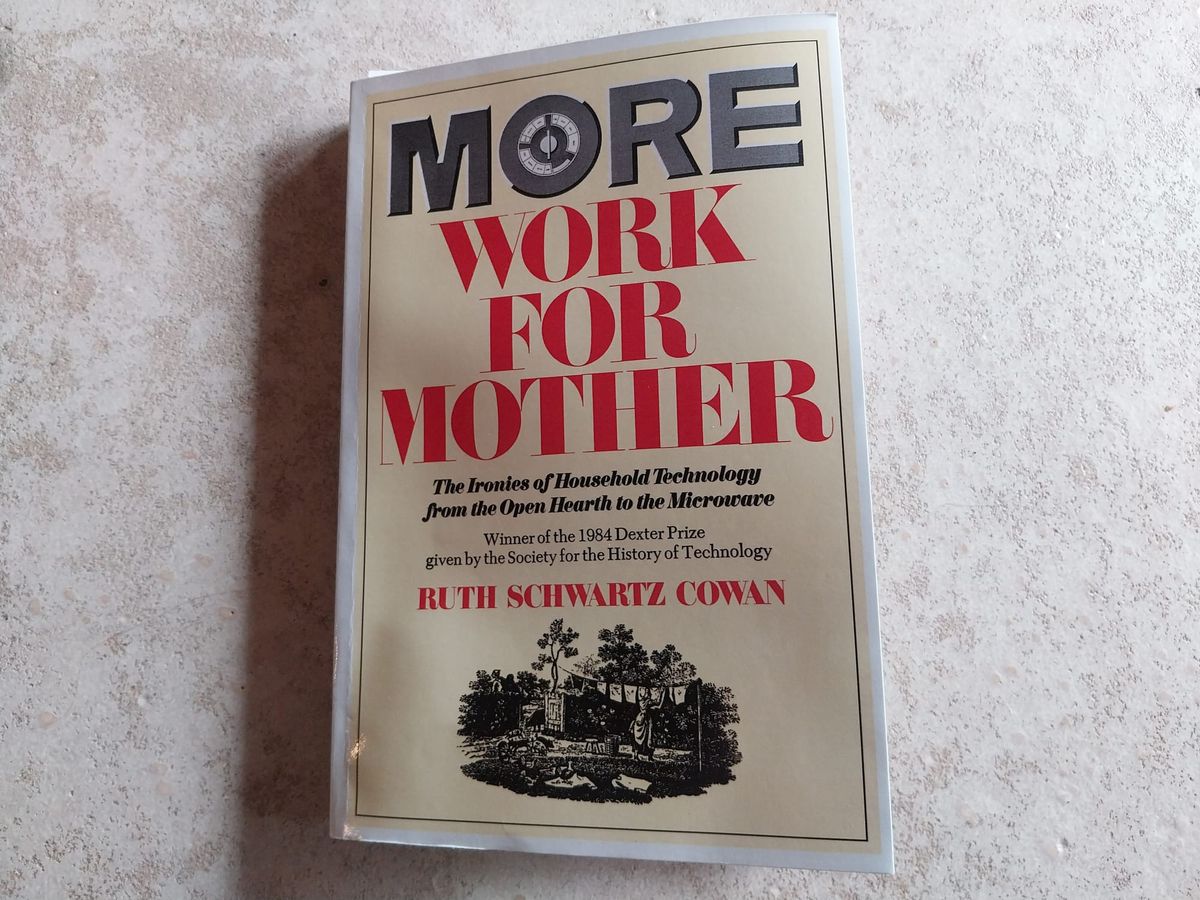
More Work for Mother is one of those books I half-read, over a decade ago, because I needed some information from it while writing my doctoral dissertation. It was very obviously a book deserving of an actual time investment. Finally, I've gotten around to putting the time and effort into reading it properly. I'm glad I did, and would recommend it to basically anyone, especially if you're interested in labour, the history of technology, gender, the relationship between work and family life, or how certain technologies "win" over others. It's a wonderful book for de-naturalizing assumptions one might have about how we got to where we currently are, from a technology and labour perspective.
What's it about, then? In More Work for Mother, Cowan makes the argument that the development and popularization of household technologies has not, in fact, saved the labour of women. So-called labour-saving appliances, she argues, disproportionately save the labour of men and children in the home, while either not saving labour for women, or indeed increasing the standards which women must meet in their household tasks and management. A tidy example of this is laundry: where a woman of comfortable means might previously (depending on the era) have either had paid laundry help in the home, or have sent her laundry out to be done commercially, the advent of the home washing machine moved that labour into the hands of the comfortably-situated woman herself. Combine that with the increase in number of garments and linens owned, as well as an increase in standards of cleanliness, and our woman of comfortable means has moved from not doing laundry herself at all, to doing all of it, and the all of it is more than it used to be.
What, you may ask, of the woman of less-comfortable means? Cowan has got our backs on this one as well. Our householder of more meagre status has suffered a similar trajectory as our comfortable householder, just with a different starting point. While she may have previously done all of her household's laundry herself, two centuries ago, that would have been quite a small number of items, and their washing would have been pretty intermittent. Deploying data on household labour from the middle of the 20th century, Cowan shows us that the woman of less-than-comfortable means was, by the 1950s and 1960s, expected to keep her home and family in conditions much closer to those of her wealthier counterpart. A nice win for class equality, maybe, but not for the capacity of our meagrely-provisioned householer to have her labour saved.
Laundry is just one example among many in More Work for Mother. What's perhaps most compelling about it is the way Cowan so skilfully uses a centuries-long history of life in the United States (as many good histories are, this book is quite geographically-bounded) to support her argument. One by one, she grabs all the arguments about "the modern housewife having it easy" (this book is circa 1983, so the word "housewife" is a lot more prevalent than we might now expect it to be) and smashes them to pieces with real, specific, and well-grounded counterpoints. It's also a pretty nice read, which isn't always the case with well-constructed and -supported history books. If you, like me, have managed to get this far in your life without reading More Work for Mother, fix that oversight now.