Bookpile 14: The Five Dollar Day
Bookpile is short posts on Fridays about what I’m reading now and what I’m liking about it. This week, it’s The Five Dollar Day, by Stephen Meyer III.

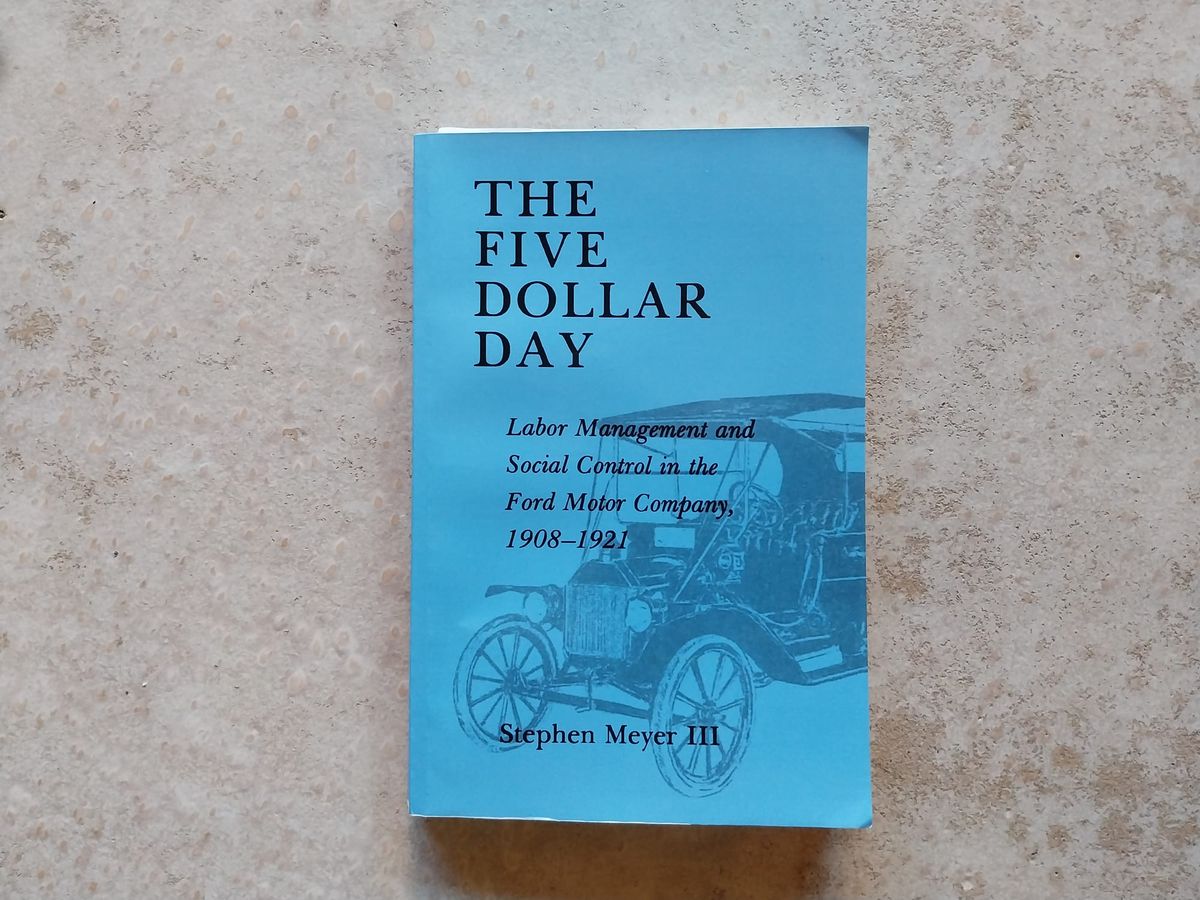
This one is a bit niche. The Five Dollar Day: Labor Management and Social Control in the Ford Motor Company, 1908 – 1921 (by Stephen Meyer III, 1981, SUNY Press) is one of those history books that picks a small period and a specific case, and does it thoroughly, with a lot of good archival material. It's good, solid, scholarly history. It's a truly excellent book, which does the thing it does well. I got to it via the footnotes in a rather broader (but still very good) book on another aspect of the history of the Ford Motor Company. But more on that another day.
The Five Dollar Day does what it says on the tin: it's about the system of labour management and social control implemented by Ford, specifically at its plants in and around Detroit, in a period of a little over a decade at the beginning of the 20th century. This timeframe falls within an era when semi-benevolent paternalism was still one of the ways industrialists controlled the lives of their workers while glossing that control with a veneer of uplift.
While Ford famously implemented daily pay of five dollars for male factory workers over a certain age, this impressive-for-the-time rate was undergirded by strict social control, supported by teams of inspectors and systems for the integration of workers into a very strict view of respectable Americanness.
I'm in the midst of reading The Five Dollar Day because I have soft spot for industrial history. But the side-quest in it is how relevant the discussion about changing systems of industrial labour a century ago continue to be today. You can read this as a book about Ford's attempt to control the home lives of workers, through a combination of strict discipline and financial coercion, or you can read it as an instalment in the history of capital's attempt to make workers fall in line with management dreams of hyper-efficient workplaces where machines set the pace and humans keep up or get left behind. Which seems... oddly relevant at the moment.