For work and for home
There has historically been a gap between the way we see industrial technologies and technologies of the home. As platform logics come to household appliances, that gap becomes more complex.


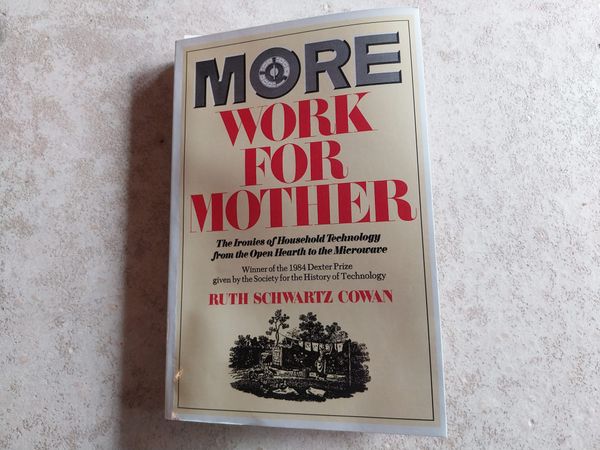
Read this alongside my essay on Design for Dreaming and my bookpile post about More Work for Mother.
Very frequently, in critical writing about technology and especially automation, the focus is and has been on work. Everyone from Karl Marx to William Blake has been concerned with the effect of new technologies on the way workers do their jobs, and the conditions under which they are asked or made to work. There is a very deep seam of mostly criticism towards the effects of mechanization on the safety and dignity of labour. Certainly in the story of the Industrial Revolution, we do not see efforts to sell mechanization to workers – in a climate where work is needed and scarce, the factory owner does not need to get the workers to buy into the idea of mechanization. This is especially the case if the government and its force (both legal and physical) are motivated to promote the interests of factory owners.
Mechanization at work is a long-standing topic of writing in technology criticism, and has tended to overshadow and outweigh discussions about technology adoption in other spheres of life. This is pretty fair within the history of these critiques, given that many of the biggest social changes being wrought with the help of technology have been in industrial contexts. Until the 20th century, leisure time and discretionary spending weren’t major facets of life for most people in then-Industrializing countries (though if you want to read a good nuancing of this, do check out More Work for Mother, which covers a rather longer history of household technology). But in the 20th century, technology outside of work contexts became much more important, and it especially ramped-up after the Second World War.
In the hyper-consumer decades after WWII, there was a glut of new technologies for the home – and these were frequently presented as liberatory. The housewife (let’s be clear: the middle class, white housewife), that toiler of old, could be off playing tennis and joining the ladies for bridge once she secured the services of a dishwasher or a microwave. In the North American imagination at least, the riches of post-WWII industrial capacity were offered (for a price, obviously) to consumers. The wife, back home after her war work, and once again making house for her working husband, may have needed a little seduction to accept the bargain. A little extra convenience, a little extra time for herself, in order to buy into the idea that she shouldn’t be agitating for her place in the workforce. This set the stage for new technologies and automations in the home to be a desirable technology that the user is invited to purchase and use. The cost of adoption is an outlay of money, and the benefit is more time and less effort to achieve the same (or an even higher) standard of household functionality, grace, and ease.
Technology at work is a different box of rivets. The decision-maker in the process of adoption is not the worker, not the actual user of the tool. Unlike our mid-century housewife, who may or may not be holding the purse strings, but who does have the capacity to agitate for a microwave, the factory worker is less directly positioned to ask for technologies which will make his work easier or more comfortable. Instead, the factory owner is the one making the decisions, not generally with the ease of the worker in mind, but with the question of cost informing his choices. The factory owner aims to use technologies which increase his profit, whether through the de-skilling of workers, or through an increase in factory throughput. This looks a lot like the dynamic we see critiqued in Industrial Revolution-era adoption of new technologies at work.
Benefits for who?
We have two different mechanisms in play, based on who is meant to benefit from a new technology. Conveniently, in both our scenarios, the beneficiary is the customer. We can map it fairly easily: our 1950s housewife wants a dishwasher and sets about acquiring it. She expects to be the one benefiting from this new form of household automation. Perhaps the children will load and unload the dishwasher. Perhaps our housewife is not the one handing over the money. She is still the customer in the arrangement, as the one wanting the dishwasher and the benefits it has to offer. She will be the one capturing the utility of the dishwasher and benefiting from the adoption of the new technology. At work, our factory owner is the customer and beneficiary. He wants his factory to run more efficiently in terms of turning fewer inputs (money, time, labour, materials, overheads) into more outputs (whatever product he is selling). While his choice of a new technology may incidentally result in side benefits for his workers (say, a conveyor belt could potentially take a straining and physically heavy task away from a worker by minimizing the amount of lifting and carrying required in a production process), unless he is a very altruistic factory owner indeed, his motivation is more likely to be an increase in efficiency, capturing some extra utility from his resources.
This is a very mid-century view of technology adoption. At its core is the question: “Who benefits?” When we look at promotional materials for home technologies circa the 1950s and 1960s, the intended beneficiary is very clear: mother or wife will be able to save time and effort on her tasks when she lives in the house of the future. She is the immediate beneficiary of the new technology, and her family, for whom she keeps the nice house, are the indirect beneficiaries. The relationship of paying customer to company wanting to sell products makes the proposition very clear. And if the goal is to seduce the customer into buying a new category of product that she hasn’t previously considered necessary in her home, then the sell needs to be convincing. This is adoption by pull and by marketing, and perhaps by the desire to have what the neighbours have, finding ways to convince our customer that she really needs that new thing, and that it will make her life better.
In our factory (maybe they’re making those dishwashers or microwaves being sold to our housewife), the purchaser and the user are not the same person. While pull, marketing, and parity with their peers may be motivating the factory owner in adopting new technologies, these are not the motivations driving the factory worker to use those technologies. In a factory with top-down management (the vast majority of factories, especially in the place where this example takes place – mid-20th century North America), our worker is using the new technology because he is told to do so. If he does not want to use the technology, he may have some small degree of recourse – maybe the factory is unionized and there are opportunities to fight back against the adoption of tools and processes that could damage the wellbeing and earning potential of the workers. But in areas like the automation of heavy physical labour, the interests of the factory owner and the union can be made to align. Maybe fewer workers will be needed to carry out the same processes, but the tasks will become less demanding. A bargain can be made to keep or reassign the existing workers or to offer early retirement packages. Aligning the desires and needs of the individual worker (the direct user of the technology) with the needs of the factory owner (the customer making the decision to adopt the technology) might require a degree of negotiation – if alignment is sought at all. The other option, of course, is the “take it or leave it” attitude, with our factory owner having sufficient power to simply tell workers that this is how things are now done. What worked during the Industrial Revolution was still often successful in the 20th century.
What's at stake now?
What do we get from this parable of the housewife and the factory owner that we can use today? Can it inform our understanding of who benefits from the kinds of technologies at stake in our world? There are a few striking things. One is that with both our housewife and our factory, the beneficiary is pretty clear. In both cases, a new technology is being adopted in order to achieve some benefit, and the technology is acquired by buying it. I’m oversimplifying the finances a little. Of course our factory owner could be using credit, and of course our housewife could get that spiffy new dishwasher under a rent-to-own arrangement. But in both cases, the goal for the beneficiary is to acquire the technology that will bring them some additional utility. Our housewife wants to have the dishwasher so that she can make one household task marginally easier. Our factory owner wants his mechanized line so that he can save on his production costs. This is, of course, optimistic. The dishwasher may be bought for less utilitarian reasons than making it easier to wash dishes, and the mechanized production line might be implemented in order to more effectively control workers. But both acquisitions have theoretical benefits for their purchaser, and both involve acquiring a technology which serves to provide that benefit.
What does that have to do with today's technological landscape? For one thing, the question of who benefits is much murkier than it used to be. The question of who the customer is has become vastly more complex. For the factory owner, it’s still likely to be more straightforward. The factory owner wants equipment that reliably does what it’s supposed to do, without surprises. Beyond that, the factory owner is swimming in a much smaller pool of customers, buying more specialized technologies from a smaller number of companies. The factory owner is still likely to have a high degree of control over how the equipment works and what it does.
But on the consumer side, it’s now possible to buy a whole constellation of smart household appliances linked together by the proprietary home automation app of a major technology company. Your washing machine can come with AI, according to the marketing materials. We’re no longer dreaming of letting the kitchen bake the cake while we play tennis. Instead, we’re hooking all the appliances to the internet, scheduling or remotely starting their functions via an app, and according to a promotion from a major retailer of appliances I saw recently, getting a discount on our energy bills by buying the right brand of appliances and buying into the associated home automation ecosystem. The flows of data being produced by the appliances, their position in a proprietary digital ecosystem, and their tie-ins with services from other vendors imply that the relationship between the purchaser (or renter) of the appliance and its vendor is not entirely straightforward. Short of going through the user license agreement with a fine-tooth comb (and even then), it’s quite hard to determine who ultimately benefits in the transaction. And even if you understand the legal agreements you’re asked to consent to when joining the smart product ecosystem, this is no guarantee that you’ll like the subsequent versions you’re asked to click on when the agreement is periodically updated. This is another variation in the way we interact with products. Any form of “smart” or “connected” product entails an ongoing relationship with its vendor, including a constantly moving target in terms of legal agreements. And if you don’t like the most recent update to the Terms of Service? Stop using the product. That’s your recourse.
What all of this means is that there's still a gap between the way technologies of industrial work and technologies of work in the home configure their users, but a new layer of complexity has been added in the home. This won't be a shock for anyone who follows the tech industry, as it's more or less a transfer of established methods for profiting off of consumers from the platform economy to our home appliances. We may by now be apathetic about platform providers profiting from our data, but it's worth noticing this change. While popular discussion about developments in technology focuses on the future of work or the vulnerability of critical infrastructure, we risk trivializing yet another shift from items meant to benefit their owner, to items which put their owner at risk of further commercial exploitation.