Design for Dreaming
Design for Dreaming showcases post-WWII conspicuous consumption at its most glamorous. What was Design for Dreaming, and how can we understand its relevance 70 years later?

When I was younger, I had a mild obsession with the Prelinger Archive, a collection of ephemeral film hosted by Archive.org. That was where I watched an awful lot of advertising and instructional films from the early-to-mid 20th century. The glory of films telling teenage girls about the importance of personal hygiene! The wonder of chemicals and plastics!
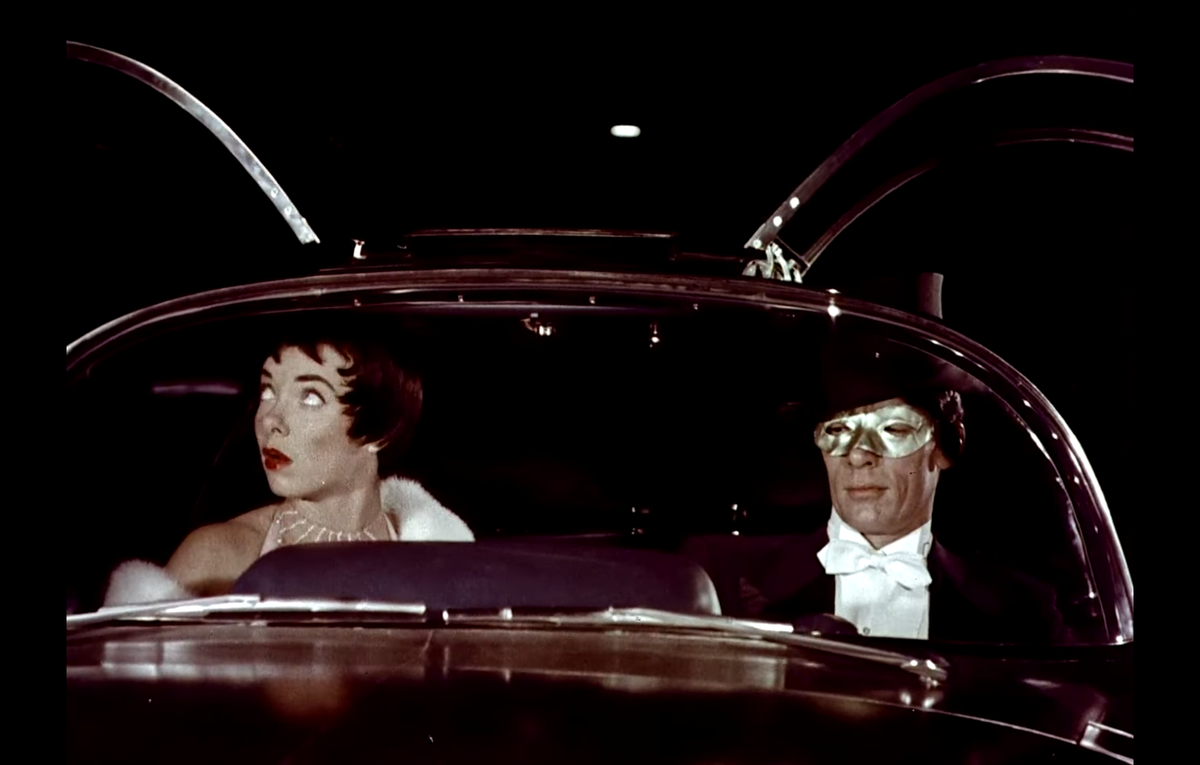
One of the most iconic of those films was Design for Dreaming, released in 1956, showcasing the latest and greatest cars from General Motors. And they were indeed great at the time. Post-WWII GM cars were sleek, attractive, and futuristic. Design for Dreaming showed those cars in their peak promotional habitat: the GM Motorama expo, a travelling setpiece of an exhibition in which GM showed off its new models, alongside other futuristic dreams like the Frigidaire kitchen of tomorrow.
I re-watched Design for Dreaming recently, while digging into the consumer visions of the 1950s and ‘60s. A goodly amount has been written elsewhere about this short film, often focusing on the creation of the middle class female consumer in the Post-WWII United States. The star of the film, and the character we viewers are meant to identify with, is a youngish woman, swept along in the joys of GM cars and pipedreams of Frigidaire appliances, by a masked man in evening dress. The two flit between various cars, all of which are thronged by Motoroma’s crowds. Our heroine dances and sings with her masked partner, together imagining ownership of a string of cars, and the lifestyle to go with them.
An interlude in the kitchen of the future shows us what her dream life could look like at home. And it is indeed her life – the masked companion is conspicuous by his absence during the kitchen sequence, leaving the female lead in her ballgown (with the addition of an apron, of course) to navigate what we are meant to understand as her space. But the kitchen of the future is labour saving! Instead of having to break her back day in and day out, this woman of the 1950s will be able to bake a cake at the push of a button and head off to the pool.
It’s an odd film, but a compelling one. Part of what makes it compelling is that it's visually appealing, while being totally un-self-conscious in its consumer optimism. We only have to think as far as the next car or appliance, and not worry about either the impacts of our conspicuous consumption, or about how we'll afford that new convertible. It's a film designed to stoke our desire for goods, and to sell us the idea that these purchases will improve our lives.
The other compelling thing about Design for Dreaming is the way it walks the line between two kinds of dream. The first kind is literal: it is framed as taking place in a dream sequence, starting with the heroine in her bedroom, pyjama-clad, before the magic of the masked man puts her into a ballgown and transports her to the Motorama. But it is also, of course, a dream of consumer modernity and convenience. It is a dream in the sense of the American dream, with the flashy car, the fitted kitchen, and a two-car garage. The fun-but-obvious doubling up of the meaning of "dream" is sitting there on the surface, letting us in on the joke, letting us draw the conclusion ourselves that the film's heroine may be having an actual dream, but these new cars could make our dreams really come true – presumably with the help of a little financing.
Even more, it’s the profound conspicuousness of the setting that makes this film so extremely watchable. Everything in Design for Dreaming is marketing. Which is to be expected, as it's a marketing film. Whether it is the marketing of cars that exist, or of fictional kitchens and concept cars, or of a happy life in the suburbs with that masked stranger, it's all being sold to us. It’s that perfect kind of 1950s aspirational, tying contentment and consumption together. Our female consumer of the 1950s is being presented a vision of what she should aspire to in life. She is being, through this kind of marketing, educated in what dreams GM would like her to have. And through GM's engagement with real consumers in its Motoramas, her acceptance of these dreams is being tested.
This brings me to the "dream car" we see at the end of the film. At the very end, after seeing the new GM vehicles for 1956 and taking a trip to the kitchen of the future, we meet the "fabulous, turbine-powered Firebird II," a car which runs smoothly on an automated highway ("the electronic highway of the future"), like a cross between a car and an airplane, with the masked man radioing a tower for clearance before our two main character take off into the proverbial sunset. Dream cars were a feature of GM's Motoramas and marketing films throughout the post-war boom period. Like concept cars at auto shows today, they existed to stimulate the imagination of consumers (Woodham, 2014, p.374), and to acclimate them to possibilities. The extremes of the dream cars also served to test demand for certain features, allowing GM's designers to gauge ahead of time whether huge fins or more chrome might be popular on production-model cars. The dream car, yet another layer of dreaming, on a similar level to the kitchen of the future, gives the viewer a shot of techno-optimism. Buying today's GM car is a little step towards the exciting futurism of the dream car.
In broad strokes, the goal of Design for Dreaming is very similar to the kinds of aspirational marketing we see today: live a better life through consumer spending. It is the ancestor of this form, being an early and iconic work of aspiration washing. As most histories of design and consumption in the 20th century will tell you, the excess manufacturing capacity in the United States after WWII led to (or reinforced if they were already there) many tropes we know today in design for excess consumption: annual model changes for cars, turning a durable good into something that becomes visually dated; the need to keep up with the Joneses by buying more things; planned obsolescence. The difference between how this manifests today, compared to how it is demonstrated in Design for Dreaming is mostly in the aesthetics and the apparently innocent optimism – consumption-as-life-changer, without irony or a cheeky wink.
References
Woodham, J. M. (2014). Advertising and Design. In The Oxford Handbook of Science Fiction (p. 364-382). Oxford University Press.