Notes on Fordism
Fordism has permeated the way not just industrial manufacturing, but broad aspects of society are managed. And it's not all conveyor belts. What values underlying Fordism shape the way we look at technology and labour today?

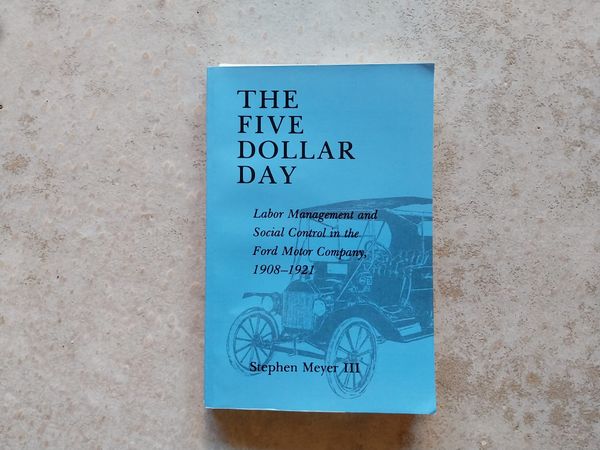
I’ve really had Fordism on my mind lately. I recently re-read Fordlandia, a very fun book about Henry Ford’s attempt to grow rubber and create a good, old-fashioned middle American idyll in the Amazon rainforest. Spurred by Fordlandia, I’ve since read The Five Dollar Day, a nice historical text on the way labour management was done in Ford’s Detroit-area plants between the start of the 20th century and the end of the first World War. Spoiler, it was with an emphasis on conformity: both cultural conformity to “American” norms and behavioural conformity to the rhythm of the factory’s machines.
The reason I’ve been digging back into Ford in the early-to-mid 20th century is because I’ve been trying to put together a little potted history of different perceptions of technology that have coexisted throughout the history of industrialization. Why yes, I do have fun hobbies. The point of this little history I’m trying to write is that the adoption of new technologies is never simple – it is always complicated and contested. This shouldn’t be a surprise, but the way histories often get told (especially by those who are in favour of the adoption of certain new and contested technologies) is as an uncomplicated march of progress, where certain wrong-headed reactionaries didn’t like the new thing, but look how well it’s all turned out, despite their complaints! This is a pretty problematic way of looking at the history of technology adoption, but it’s a narrative that’s far too easy to adopt uncritically and accidentally, as it's incredibly pervasive. So the way technologies are contested and the way these stories are formed has been occupying me lately.
For many years, I’ve been quite into how this tension played out during the 18th and 19th centuries, with hugely public, contentious, and often violent disagreement over the adoption and implementation of technologies like power looms. When trying to write my little potted history just from knowledge I already had, those early industrial years were the easier ones. But then I got to the beginning of the 20th century and realized that my major touchpoints were Frederick Winslow Taylor’s development of scientific management; and the growth of the labour movement, spurred by disasters/abuses like the Triangle Shirtwaist fire. These are fine touchpoints, and very relevant to the time, but there’s a far more emblematic example sitting out in plain sight. Hence my current small obsession with Ford – a company and a man synonymous with industrial automation and rationalization.
What Ford did
Fordism is one of those interesting terms – like Taylorism – that has become so important that it has ceased to be used. (I am shamelessly stealing the idea that Taylorism is so pervasive as to be invisible from an article I read back in 2010 or so, the title and author of which are hopelessly lost to time. But hat tip to whoever it was who previously advanced this argument, and from whom I am borrowing it.) By this I mean that the concepts driving Fordism have become totally entrenched in the way not only industrial processes work, but the way vast swathes of society are now run. Henry Ford, for all his faults (and by all accounts, there were a great many faults), managed to exert a now invisible weight on the shape of society and work. It’s Ford’s world – we’re just living in it.
Let’s pay attention to Fordism for a moment, then, and denaturalize it. Ford brought together a number of elements that were already present in manufacturing and the organization of industrial labour in the early 20th century, but refined them to a terrifying and dehumanizing degree. The de-skilling of labour was already taking place in some industries, with roundly-skilled craftworkers being replaced by machine operators making use of tools which could do one part of a job, and only that part.
The refinement of precision in the manufacture of parts was already underway, in manufacturing industries spanning from firearms to sewing machines. Greater precision in the manufacturing of parts meant that each component of the final product could be simply slotted into its place, without additional working or filing by a skilled worker. Much the same could be said of the de-skilling of workers I mentioned above: precision in the components of the manufacturing process through the creation of single-task machines meant that workers could be easily slotted into their place in the system, without much time or effort needed to educate them on their new tasks. The machines were designed to accomplish a single part of the larger process, and the workers operating those machines were de-skilled to reflect the hollowing out of their tasks. These are two elements of Fordism.
It’s perhaps the production line that Ford is most famous for. It is the visual symbol of Fordism, eliminating the need for human workers to move around during the manufacturing process, replacing the manual movement of parts from one bench to another with a seamless and constant movement of conveyor belts. As many people have pointed out before me, the production line is the visual metaphor of choice for the dehumanization of industrial labour, with the conveyor belt dictating the pace of work, and the worker struggling to keep up. From Charlie Chaplin to Lucille Ball, comedy has used the image of a conveyor belt in the mechanized factory as slapstick shorthand for the mismatch between the human worker and modern industry.
Henry Ford, being a great scavenger, was not the inventor of this kind of production. Slaughterhouses had already been using mechanized lines to speed up and make more efficient the deconstruction of animal carcasses. But automated lines were not yet the established way of working in the automotive industry. Ford (the company, not only the man), with the help of adherents to Taylor’s credo of scientific management, determined that the existing process of having humans move parts around resulted not only in wasted movement, but also provided opportunities for workers to set their own pace.
This is at the heart of Fordism (and Taylorism, to boot): the worker should not be the one setting the pace. The worker should instead be a component in the machine of the factory, slotting in, doing their bit as efficiently as possible, and with as little “wasted” movement as possible. The mechanized production line and specialized machinery allowed the design of the system to dictate the pace of movement, and thus of production. Systemic choices physicalized the transfer of discretion and planning from the skilled worker to the manager.
Let’s take this as our definition of Fordism (it is, after all, a term with many differing uses, and many nuances, so it’s fair game to nuance a definition that serves the argument at hand): systems and ideologies which attempt to increase efficiency in production (so: to reduce the number of inputs in production while maintaining or increasing the number or value of outputs) through the implementation of continuous and automated systems which place discretion and planning power in the hands of managers, and remove the need for individual workers to have specialized skills.
Fordism now
In this reckoning, Fordism is extremely everywhere. It’s not just in industrial contexts, but in any work where the addition of automation removes discretion, expertise, and pace-setting from workers. It’s in quota systems based not on a pace of work that is comfortable or physically achievable for a human worker, but instead based on the ideal capacity to which a machine should be used. It’s in leaderboards that pit staff against one another to be more productive, using gamification to push up total productivity. It’s in, in short, the relentless quest to find efficiencies and new opportunities for profit, at the expense of dignity and work satisfaction. It's in the treatment of humans as components of machines.
Fast forward a hundred years, and the automotive industry which Ford changed radically in the first half of the 20th century has continued to be a poster child for automation. Industrial robots have long had a place in many functions of auto plants, and Elon Musk has famously said that he’d like to be able to entirely eliminate the need for human labour in the Tesla manufacturing process. Henry Ford’s attempt to remove skilled workers continues, in any number of new ways to build a car with fewer, more interchangeable, and less empowered humans.
So what's the punchline? Fordism doesn't teach us that "robots will take our jobs." What Fordism and the last century of developments in the automotive industry can teach us is that humans – and the systems they deliberately design to serve the goal of removing workers they see as inconvenient, unreliable, irritating, or expensive – will be the ones to take our jobs.
References
Grandin, G. (2009). Fordlandia: the rise and fall of Henry Ford's forgotten jungle city. Macmillan.
Meyer III, S. (1981). The five dollar day: Labor management and social control in the Ford Motor Company, 1908-1921. State University of New York Press.
Winchester, S. (2018). Exactly: How precision engineers created the modern world. William Collins.