The Box
This week, I’m distilling some things we can learn from Marc Levinson’s 2006 (or in the second edition, 2016) book, The Box. The Box tells the story of the intermodal shipping container, an object you may not even know you should care about.

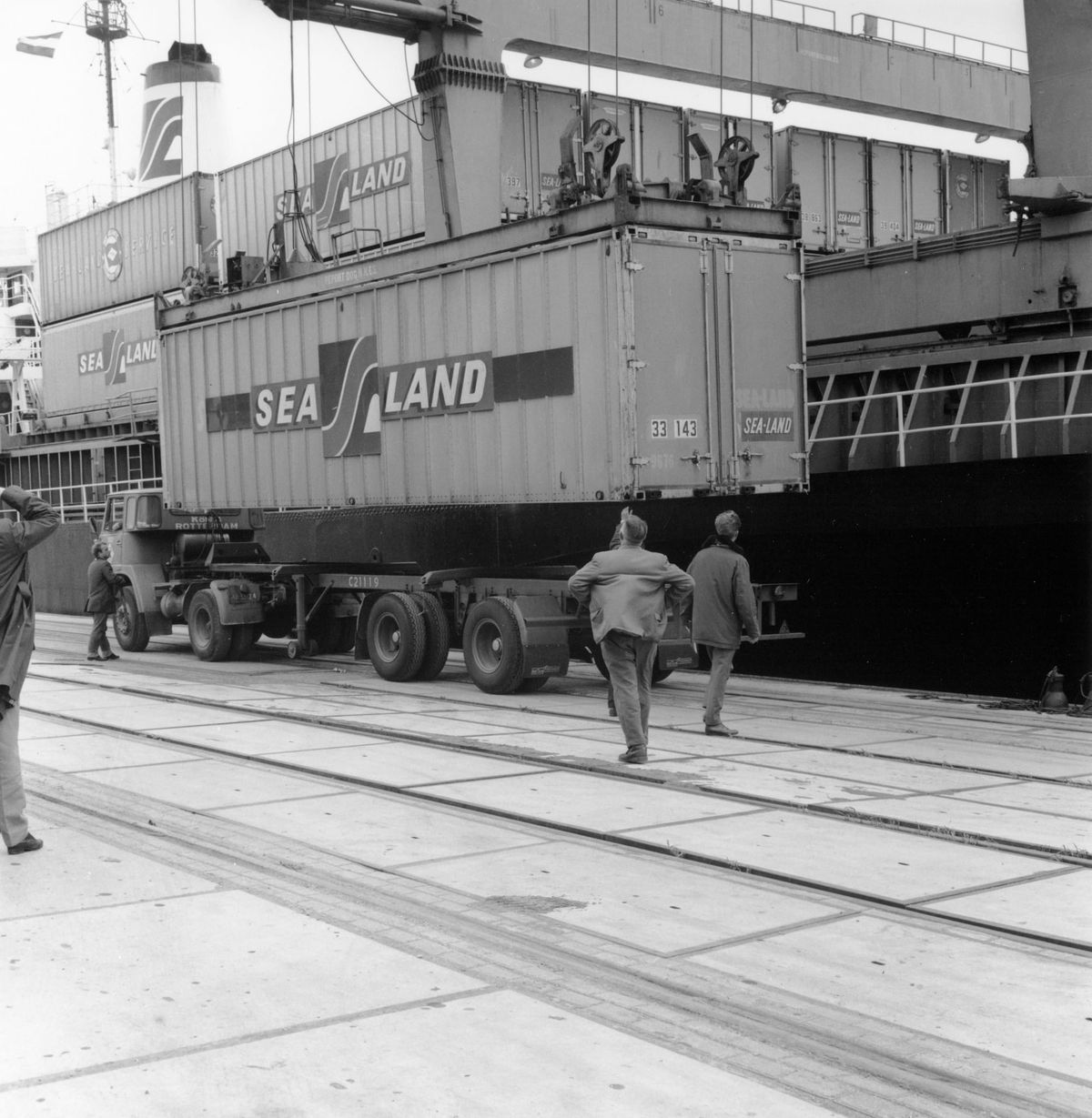
Most of the goods you use and consume have probably seen the inside of a shipping container. You know shipping containers: those big metal things on the backs of trains, stacked on ships, sitting in huge piles near docks. Made of corrugated metal, painted in the livery of their owners. They’re the workhorses of global trade, increasing the speed at which a ship can be unloaded, compared to the pre-container era of cargo being emptied by hand, with the help of hooks and nets. Marc Levinson’s 2006/2016 book, The Box tells the story of the origin and growth of the shipping container.
Levinson starts the book by positing that no one has previously written a thorough history of the shipping container. In The Box, Levinson aims to remedy that oversight. And does he ever. The undeniable through-line of the book is Malcom (yes, Malcom, not Malcolm) McLean, a trucker turned logistics magnate. But though there are moments that risk becoming solely-focused on McLean, Levinson tidily packs in other players and factors, other simultaneous threads of the story. It does not become the hagiography of Malcom McLean and his single-handed invention of the shipping container, but is instead a well-balanced and thorough story of how a confluence of factors and events led to a total change in the shipping industry. But of course, it’s still mostly a story about the winner, which means that when competing players in the attempt to create and standardize shipping containers are mentioned, it’s in counter-point to the shipping container we know today. It’s the story of the shipping container, not of the potential shipping containers we might have had, if things had gone differently. (Though I’d love to read that book, if anyone ever writes it.)
Why it matters now
You may not think you care about shipping and logistics. Indeed, you may also wonder why I’m boring you with a book that was originally released (to much fanfare and attention) twenty years ago, and which has already had an expanded second edition (and that, ten years ago already). Well. As we’ve repeatedly learned in the last six years, with the us-first approach to production and distribution during the early-Covid area, then the blockage of the Suez Canal by the Evergiven, and now by the global price and inflation implications occasioned by the closure of the Strait of Hormuz, shipping really matters. The interconnectedness on which our everyday lives rely is very significantly facilitated by (and Levinson argues, more than partially caused by) the work of the humble shipping container. (Though if I’m being really precise, I’ll admit that one of the biggest issues caused by the closure of the Strait of Hormuz is a blockage in oil transport, implicating tankers, rather than container ships. But still. Shipping matters.)
It’s hard to deny the significance of the shipping container in moving items around the world. In the pre-container era, loading and unloading ships took more labour and more time. Goods removed from ships needed to be moved in smaller units, warehoused, and laboriously re-configured and re-loaded at every step. The marvel of the container era is that items can be packed into one large, standard-sized box at their point of origin, and not touched again until they reach their final destination. The move to containerization of cargo allowed the full-scale automation we now see in certain parts of the shipping process, with essentially no human intervention required in processes like moving a container from a ship onto a train in some ports. This is, to put it bluntly, bananas, if you put it into the context of how shipping used to be handled, and how legions of workers previously serviced the shipping industry. Hard, dangerous, and casual labour has, over the course of seventy years, been replaced by significantly less labour, with the remainder being predominantly administrative or focused on security. Shipping is a fascinating microcosm of automation, and the processes, impacts, and arguments around it. And all of that, aided by the development and standardization of the shipping container, mundane as it may seem.
The shipping container, then, is a beautiful example of why boring things and background things are important (thank you, Susan Leigh Star). And that's why The Box continues to be relevant, two decades after its original publication. In weaving the history of the shipping container, Levinson brings together threads as diverse as the role of the Vietnam war, how the United States used first-mover advantage to make its standards into the world's standards, and changes we've seen in the last half-century to the global distribution of manufacturing. If the history of the shipping container can remind us of anything, it's that we now live in a profoundly interconnected world – and that has consequences for everyone.