Not another industrial revolution
The term "Next Industrial Revolution" is often used as a way to silence dissent or create buy-in. We treat the concept of an industrial revolution as if it signals inevitability. This ignores the complexity, power, and dissent that featured in the First Industrial Revolution.

I am not a historian, but a lot of the work I've done has engaged with the Industrial Revolutions (both the one with the steam and the one with the electricity). I extensively read the work of actual historians on these periods, and am of course also into the work that scholars in History of Science and Technology have done to add complexity to popular but incomplete linear historical narratives of technological progress. This is important to me because I've mostly spent my research career studying things that people think will be "The Next Industrial Revolution." A decade ago, I did my PhD on 3D printing and other forms of digital fabrication. These technologies were supposed to change everything, do away with mass production, and decentralize manufacturing. 3D printing has definitely been implemented in some industries. But it was also already present in a few industries, doing nice, quiet, niche tasks, long before the general public (along with the people wanting to make a buck off the general public, and the people riding the hype wave) were excited about it and thinking of it as a potential revolution. It's a cool technology, and many people have good and interesting uses for it, but it hasn't changed everything.
Now, I have the – let's call it fortune – to have been studying the social implications of "AI" at the moment when it suddenly became the next "Next Industrial Revolution." This one has a lot more money behind it, and is being pushed much harder than 3D printing. A lot of very big companies are very interested in trying to make money off of whatever the hell this technology turns out to be. And a lot of governments are incredibly keen to get in on the game, because they've been convinced that they'll be "left behind" if they don't jump on the bandwagon and replace their existing processes with an ecosystem of "AI" tools. So here we go again, basically. People keep on effing talking about the thing that's happening right now as if it's inevitable. As if it's just going to happen to them, no matter what. And then. This characterization of "AI" as the next "Next Industrial Revolution" wraps it in a really unhelpful conceptualization of futility. We look back on previous industrial revolutions as things that could not be helped. They just happened, and they happened to populations of people, whether those people wanted them or not. They were, in short, inevitable technical progress. Like a force of nature, but wholly unnatural.
The problem with this way of thinking is that that's not how it happened. Choices were made. By people. By governments. By companies. It's just not the case that the spinning jenny or the power frame (both key elements of the industrialization of the textile industry) were invented and then everything else inevitably followed. That is not how societal changes involving technology work. Life is not deterministic like that. It takes intervention, and it involves power. Previous industrial revolutions only feel inevitable because they're what happened, and our popular narratives of past technological change spend very little time addressing the things that didn't happen, or the things that happened but can't be packaged nicely into a tidy narrative. (And for a great source on technologies that didn't "win" you can't do much better than Ruth Schwartz Cowan's book, More Work for Mother, which I've written about previously.)
Dissent exists and existed
To take one example: the Peterloo Massacre was the British government deciding to use military force against a protesting citizenry. Working-class people seeking the right to vote were organizing in support of Parliamentary reform, and the government chose to send in troops to break them up. People seeking enfranchisement died because those governing the country were not interested in having their power diluted. Now, I realize that the quest for the vote may seem like a bit of a sideline in the history of industrial revolutions, but it's all of a piece. The conditions that led to the Peterloo Massacre came out of industrial organizing in the textile industry, dissatisfaction with laws that prioritized the well-being of haves over have-nots, and economic hardship for a massive proportion of the population. To put it excessively simply, the choice of government to prioritize the vested interests of the rich over the well-being of the rest of the population created conditions which ultimately resulted in extreme government violence against working-class demonstrators seeking the right to representation. It sounds terrifyingly familiar and current, but it happened over two hundred years ago.
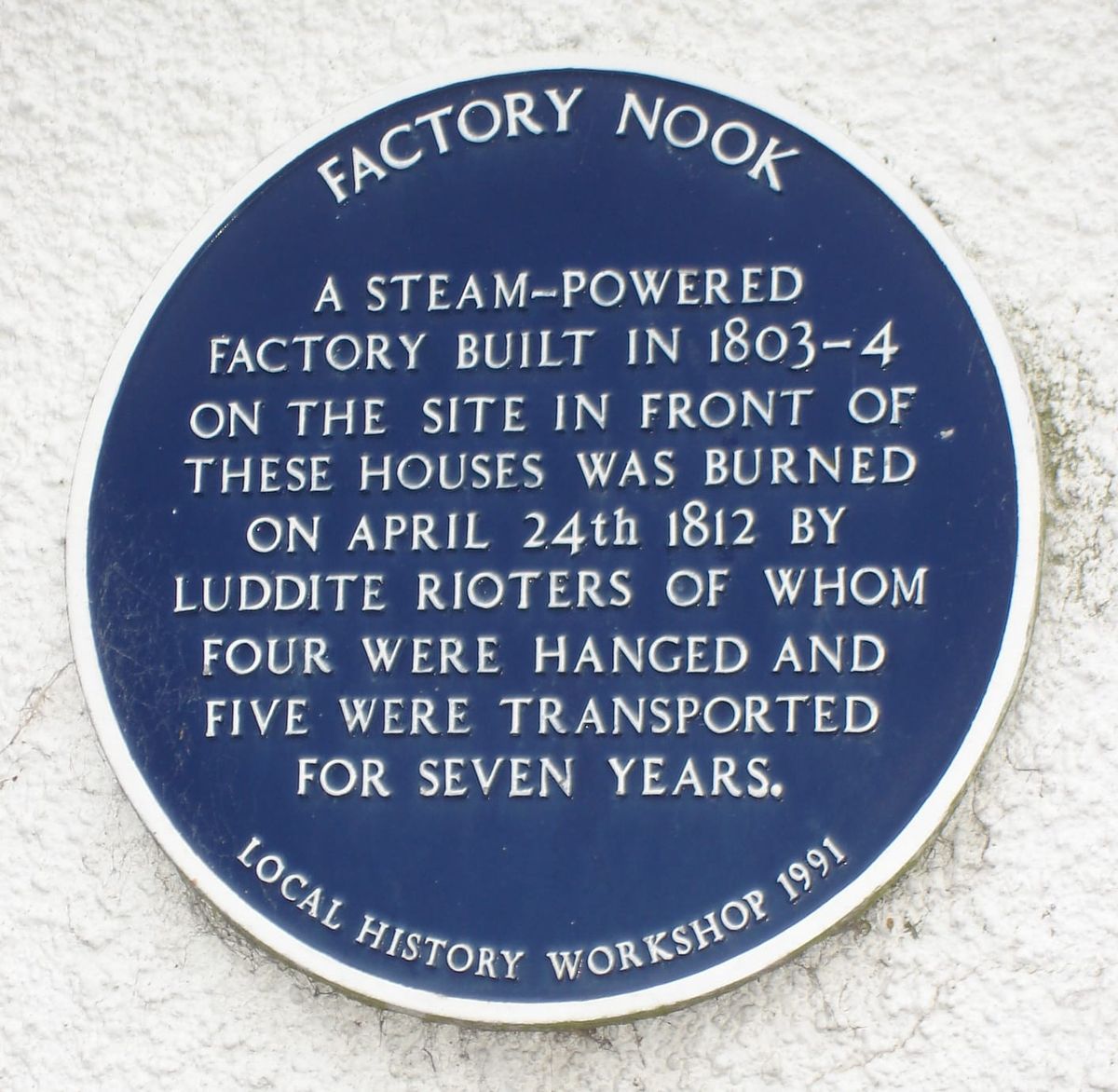
The way levers of power were pushed for the benefit of some over others around the time of the Peterloo Massacre doesn't look like a unidirectional kind of technology-led progress. The existence of the technologies that helped consolidate wealth during the steam-based First Industrial Revolution did not inevitably lead to that consolidation. Workers quite reasonably protested against the worsening of their working conditions, against laws which de-prioritized their interests, and against attempts to remove what control they previously had over their labour. Power looms did not, by themselves, lead to the de-skilling of weavers and the movement of power from weavers to factory owners. But the adoption of power looms en masse by wealthy factory owners capable of laying down capital, the creation of laws which heavily penalized those who broke power weaving equipment, and the brutal subjugation of workers who protested sure helped in the advancement of a particular type of industrialization. Protesting workers were not "anti-technology" or "anti-progress," they were against the way their agency was being diminished, against exploitation. In hindsight, they get viewed as "anti-progress" because the factory owners won. The changes those workers fought against became part of our unidirectional story of progress, but that didn't need to be the case. Different social and political structures could have resulted in different choices. None of it was inevitable.
History is leveraged by people who want to be winners
It is a specific strategy to talk about "AI" as the "Next Industrial Revolution" and it is one that deliberately trades on inevitability and powerlessness for the majority of people. Because our conception of "The Industrial Revolution" is essentially a thing that happened, with great force, and which changed the way everyone lives and works, this is a handy shorthand for "we think you should think this technology is inevitably going to change everything." Our lack of understanding of the contestation that took place during the various previous industrial revolutions, the political and power-based choices that were made, and the emphasis on telling the history of the powerful means that we have the bad habit of not grasping the whole story of important social changes that had technological components. We hear "industrial revolution," swap in our shorthand understanding of what that means, turn our brains off, and read the next new thing as "inevitable social change caused by the invention of a technology."
People like to say that history is written by the winners. It's a classic aphorism, generally used to explain the unevenness of representation in historical narratives. The problem with the way the concept of a "Next Industrial Revolution" is used is that it is not only a flattening of the complexity of various industrial revolutions, but it is also a foreclosure of the future. Those who want to be writing the history use this shorthand to already argue that the outcome they want is inevitable. By framing a particular potential change as an industrial revolution, the potential change is presented as inevitable. This denies the complexity of choices, politics, and dissent that took place during previous industrial revolutions. And because the popular imaginary of an inevitable industrial revolution denies meaningful dissent and power struggles, invoking that term to describe new technological developments rides on those inevitability coattails. Instead of believing in a set of inescapable changes that happen because of the mere existence of a technology, we need to remember that choices are being made, those in power are greasing the slide, and protest and dissent are still meaningful responses. Previous industrial revolutions were not pre-determined or inevitable, and neither is what's happening now.